iARM
intelligent Active Radio Module
intelligent Active Radio Module
The interoperable ISM-RF-MESH communication module iARM is suitable for mounting on a luminaire pole and communicates with the iLC-RS and iPC-RS luminaire controllers via RS-485 (half-duplex) using the Modbus protocol, thus ensuring integration into the standardised 2.4 GHz frequency band.
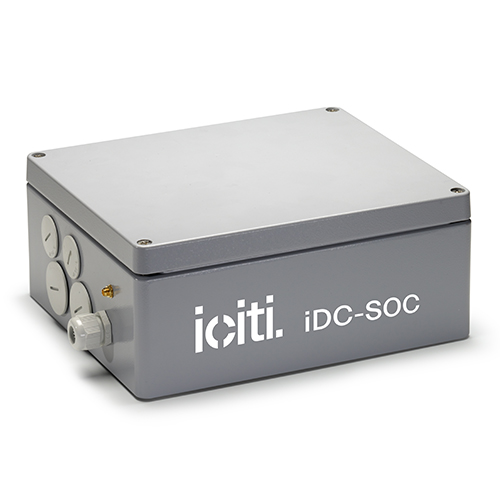
The iARM in combination with the RS luminaire controllers allows the simple supplementation of existing powerline street lighting systems to radio controls. The iARM also serves as an RF MESH interface for the iDC-SOC edge controller.
Data transmission is in accordance with ANSI/CTA 709.11 and EN 14908-11. It is possible to operate either as part of a lighting management system using the LonMark® OLC profile or as a stand-alone system with predefined lighting profiles. The iARM takes over the function of wireless transmission of information from controller to controller and each unit can be programmed and updated OTA (over-the-air).
Product Benefits
- Integrated light sensor
- Location positioning and synchronisation via GPS/GNSS
- LON node with OLC profile
- Mesh repeater/LON router on demand
- RS-485(half-duplex) interface with termination
- Management functions
- Power consumption: 500 mW
- Connection of Modbus devices from other manufacturers possible
- 2 years warranty


Typical Applications
Radio-controlled data transmission in combination with RS luminaire controllers for controlling the lighting of
- Street and building lighting
- Car parks, bus stops and railway stations
- Company premises, warehouses
- Sports facilities
Downloads

The interoperable ISM-RF-MESH communication module iARM is suitable for mounting on a luminaire pole and communicates with the iLC-RS and iPC-RS luminaire controllers via RS-485 (half-duplex) using the Modbus protocol, thus ensuring integration into the standardised 2.4 GHz frequency band.
The iARM in combination with the RS luminaire controllers allows the simple supplementation of existing powerline street lighting systems to radio controls. The iARM also serves as an RF MESH interface for the iDC-SOC edge controller.
Data transmission is in accordance with ANSI/CTA 709.11 and EN 14908-11. It is possible to operate either as part of a lighting management system using the LonMark® OLC profile or as a stand-alone system with predefined lighting profiles. The iARM takes over the function of wireless transmission of information from controller to controller and each unit can be programmed and updated OTA (over-the-air).
Product Benefits
- Integrated light sensor
- Location positioning and synchronisation via GPS/GNSS
- LON node with OLC profile
- Mesh repeater/LON router on demand
- RS-485(half-duplex) interface with termination
- Management functions
- Power consumption: 500 mW
- Connection of Modbus devices from other manufacturers possible
- 2 years warranty
Typical Applications
Radio-controlled data transmission in combination with RS luminaire controllers for controlling the lighting of
- Streets
- Car parks
- Bus stops and stations
- Industrial facilities and warehouses
- Sports facilities
Downloads
-
Technical Details
-
Circuit Diagrams
-
Accessories
-
Tender Text


SA12-4P connector plug with 4 connection cables, cable ends stripped 50 mm, 3 mm tinned

Extension cable with male/female plug for electrical connection of the iARM module to the iLC-RS/iPC-RS light Controllers or the iDC edge controller


Tender Text - Intelligent Active RF Mesh Radio Modules (iARM & iARM-I)
1. Brief description
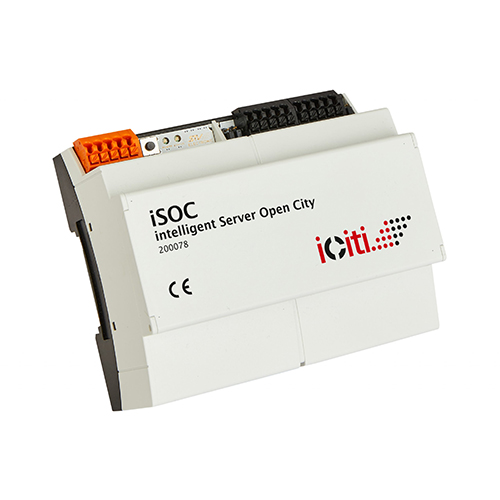
An interoperable, active radio module for integrating luminaire controllers and edge controllers into a self-configuring, full-duplex RF mesh network operating in the licence-free 2.4 GHz ISM band. The module communicates via a terminated RS-485 half-duplex interface based on the Modbus protocol and is compatible with the LonMark® OLC profile. The iARM version is used for the wireless connection of the iLC-RS and iPC-RS luminaire controllers; the iARM-I version provides the RF mesh interface for an iDC/iDC-SOC or iSOC/iSOC-S edge controller.
2. Detailed description (system description)
Configuration of an open, interoperable communication infrastructure for wireless street and parking lot lighting, as well as for expanding existing powerline systems to include RF mesh communication. The iARM active wireless module is mounted on the light pole and integrates light controllers or Modbus devices connected via RS-485 into the standardized 2.4-GHz frequency band. Depending on the system configuration, the module can be used as a LON node, mesh repeater, or LON router.
Radio transmission occurs via full-duplex communication with simultaneous sending and receiving on two channels, as well as dynamic selection from up to 80 channels. Communication is based on the LON protocol in accordance with ANSI/CTA 709.1 and 709.11, as well as EN 14908-1 and EN 14908-11 (in preparation). Unicast, broadcast, and groupcast are supported; data transmission is encrypted using AES 128. A self-configuring mesh network with up to 100 hops enables a consistent data rate and a latency of less than one second.
An integrated light sensor and GPS/GNSS for localization and synchronization provide local measurement and management information. Firmware updates and parameter changes can be performed via OTA wireless transmission; with the iARM-I, updates and parameter configuration are also possible via Modbus. The robust, UV-resistant design with IP67 protection and pole mounting is intended for long-term outdoor use.
3. Technical Specifications (Items in the Specification of Works)
Item 1: High-Level System Description & Communication Architecture
Technical Specification
Active RF mesh wireless module for the interoperable integration of lighting controllers, edge controllers, and wired Modbus sensors or actuators into a standardized, self-configuring wireless network. The system is suitable for outdoor use and complements existing powerline street lighting systems by supporting wireless communication as well as the establishment of standalone RF mesh structures.
Radio Communications and Interoperability
- RF Mesh Full-Duplex: Simultaneous transmission and reception on two channels with dynamic selection of up to 80 channels.
- Frequency range: 2.4 GHz; supported ISM band: 2,400 to 2,480 MHz.
- Transmit power: 10 dBm.
- Modulation: LoRa in accordance with ISO-OSI Layers 1 and 2.
- Data transmission in accordance with the LON protocol, ANSI/CTA 709.1 and 709.11, as well as EN 14908-1 and EN 14908-11 (in preparation), corresponding to ISO-OSI Layers 1 and 2.
- Communication organization: CDMA/FDMA (Collision/Frequency Detection Multiple Access).
- Net data rate for wireless communication: up to 100 kB/s.
- Communication modes: Unicast, Broadcast, and Groupcast.
- Encrypted data transmission: XTEA and AES 128; expandable via software update.
- Mesh network with up to 100 hops; latency less than 1 second; constant data rate per subnet of up to 100 kbit/s.
- Network organization according to the ISO-OSI layer model, Layer 2 or 3; self-configuring.
Interfaces, Sensors, and Management
- RS-485 half-duplex interface with termination; compatible with the LonMark® OLC profile.
- Connection of any wired Modbus sensors and Modbus actuators.
- Integrated brightness sensor with a measurement range of 0 to 120 kLux.
- Integrated GPS/GNSS receiver for localization and synchronization.
- Integrated radio antennas.
- OTA firmware updates and parameter configuration via radio; for the iARM-I, additionally via Modbus.
- Brightness measurement data acquisition.
- Use as a LON node with the OLC profile in conjunction with iLC-RS or iPC-RS, and, as needed, as a mesh repeater or LON router.
Item 2: Functional Requirements / Device Functions
The active wireless modules offered provide the following communication, expansion, and management functions directly in the field:
System Integration and Operations
- Wireless transmission of information between controllers within a self-configuring RF mesh network.
- Interoperable operation based on the LON protocol and the LonMark® OLC profile.
- Stand-alone operation with predefined lighting profiles in combination with compatible lighting controllers.
- Integration of RS lighting controllers (iLC-RS or iPC-RS) via Modbus/RS-485.
- Use as an RF mesh interface for an iARM-I edge controller.
- Expansion of existing powerline street lighting systems to include wireless control.
- Connection of wired Modbus devices from other manufacturers.
- Establishment and monitoring of the mesh structure and conversion of the dynamic mesh network into a static LON-type structure with or without the Edge Controller (iDC-SOC or iSOC/iSOC-S).
Local Functions
- Measurement of ambient brightness via an integrated sensor.
- Localization and time synchronization via an integrated GPS/GNSS receiver.
- Dynamic forwarding of telegrams within the mesh network with up to 100 hops.
- OTA parameterization and OTA updates via radio.
- For the iARM-I model, additional firmware updates and parameter configuration via Modbus.
- AES-128 encryption of radio communication.
Item 3.1: Base Unit A – Active Radio Module, Type: iARM
Technical Specification
Electronic, interoperable RF mesh radio module for the iLC-RS or iPC-RS luminaire controllers. The device is designed for mounting on a light pole and fully meets the general requirements of items 1 and 2.
- Manufacturer:
iCiti iARM (Ref. No. 200071) or equivalent. - Input voltage:
9 to 24 V DC; powered via the connected RS luminaire controller or a separate 12 V/24 V power supply. The luminaire controller and power supply are not included. - Power consumption:
500 mW. - Communication:
RF mesh full-duplex with dynamic selection of up to 80 channels; 2.4 GHz; 10 dBm; LoRa modulation; LON protocol according to ANSI/CTA 709.1/.11 and EN 14908-1/-11 (EN 14908-11 in preparation); CDMA/FDMA; up to 100 kB/s net; unicast, broadcast, and groupcast; unacknowledged, soft-acknowledged, and acknowledged communication services; AES-128 encryption. - Supported frequencies:
2,400 to 2,480 MHz in the unlicensed ISM band. - Mesh network:
Up to 100 hops; latency less than 1 second; consistent data rate of up to 100 kbit/s; self-configuring network organization according to ISO-OSI Layer 2 or 3. - Software interface / control output:
RS-485 (half-duplex), compatible with the LonMark® OLC profile. - Light sensor:
Integrated; measurement range 0 to 120 kLux. - External sensors and actuators:
Connection of any wired Modbus sensors and Modbus actuators. - GPS/GNSS receiver:
Integrated. - Antennas:
Integrated. - Firmware Update / Parameter Configuration:
OTA (over-the-air) via radio. - Measurement Data Acquisition:
Brightness. - Connection:
4-pin bayonet connector, male. - Operating Temperature Range tc:
–25 to +85 °C. - Storage Temperature Range:
–25 to +85 °C. - Humidity:
5 to 95%, non-condensing. - Protection rating:
IP67; UV-resistant materials. - Impact resistance:
IK09 for vertical impact / IK07 for lateral impact. - Compliant Standards / Directives:
CE; RoHS 2011/65/EU; EN 61547; EN 55015; EN 61000-6-2, EN 61000-6-3, EN 61000-4-2, EN 61000-4-3, EN 61000-4-4, EN 61000-4-5, EN 61000-4-6, and EN 61000-4-11; EN 301489-1/3; EN 300328. - Housing Material:
Housing made of Fillamentum ASA Extrafill; sight glass made of acrylic. - Dimensions (Ø x H):
Ø 25 x 153.1 mm; dimensions include the sight glass and electrical connector on the bottom. - Mounting:
Mounting plate made of Fillamentum ASA Extrafill with two mounting holes (Ø 4 mm) spaced 33 mm apart; pole mounting hardware included. - Weight:
70 g. - Customs Tariff Number:
8517 6200. - Certification:
CE. - Warranty:
2 years..
Item 3.2: Alternative Item B – Active Radio Module, Type: iARM-I
Technical Specification
Electronic, interoperable RF mesh radio module serving as a radio interface for an iDC/iDC-SOC or iSOC/iSOC-S edge controller. Unless otherwise specified below, all technical requirements of the base item iARM apply.
- Brand:
iCiti iARM-I (Ref No. 200072) or equivalent. - Application:
RF mesh interface for the edge controller iDC/iDC-SOC or iSOC/iSOC-S. - Input voltage:
9 to 24 V DC. The power supply must be provided in accordance with the system integration; a separate 12 V/24 V power supply is not included. - Power consumption:
500 mW. - Software interface / control output:
RS-485 (half-duplex), compatible with the LonMark® OLC profile. - Firmware Update / Parameter Configuration:
OTA (over-the-air) via radio and additionally via Modbus. - Connection:
4-pin bayonet connector, male. - Operating Temperature Range tc:
–25 to +85 °C. - Storage Temperature Range:
–25 to +85 °C. - Protection rating / Impact resistance:
IP67; IK09 for vertical impact / IK07 for lateral impact. - Dimensions (Ø x H):
Ø 25 x 153.1 mm; includes sight glass and electrical connector on the bottom. - Weight:
70 g. - Certification:
CE. - Warranty:
2 years.
Item 4: Optional Accessories – Connectors and Extension Cords
Technical Specification
Electrical connection accessories for the SA12 connector series, used to connect iARM modules to iLC-RS/iPC-RS lighting controllers or anedge controller iDC/iDC-SOC or iSOC/iSOC-S.
- Connector:
Type iSA12-4P (Ref. No. 200110); female; four connection wires; cable length 1,000 mm; cable ends stripped 50 mm and tinned 3 mm. - 1-meter extension cable:
Type iSA12-4P-1m (Ref. No. 200111); female and male; cable length 1,000 mm. - 2-meter extension cable:
Type iSA12-4P-2m (Ref. No. 200112); female and male; cable length 2,000 mm. - 8 m extension cable:
Type iSA12-4P-8m (Ref No. 200113); female and male; cable length 8,000 mm. - Connector series:
SA12. - Number of poles:
4. - Conductors:
Material: tinned copper; cross-sectional area 0.3 mm²; number: 4. - Insulation:
Rubber sheath. - Outer diameter of conductors:
6.8 mm. - Rated voltage:
300 V. - Rated current:
5 A. - Operating temperature:
–40 to +105 °C. - Protection rating:
IP67. - Locking mechanism:
Internal bayonet; push-pull. - Country of origin:
China. - Customs tariff number:
85069090.
Item 5: Planning and Installation Instructions
- Power Supply
For both models, a power supply in the range of 9 to 24 V DC must be ensured. For the iARM, power can be supplied via the connected RS lighting controller or via a separate 12 V/24 V power supply. The specific power supply for the iARM-I must be provided in accordance with the system integration. Separate power supplies are not included in the scope of delivery. - Mounting:
The wireless module must be mounted on the light pole using the pole mount included in the scope of delivery. The mounting position must be selected so that wireless communication and the integrated brightness sensor are not impaired by structural obstructions. - Connection Accessories:
The required connectors or extension cables must be specified separately according to the installation situation. - Standards Status:
EN 14908-11 is in preparation, as indicated in the data sheet. When issuing the request for proposals and conducting acceptance testing, the certification and standards status applicable at the time of installation must be taken into account.