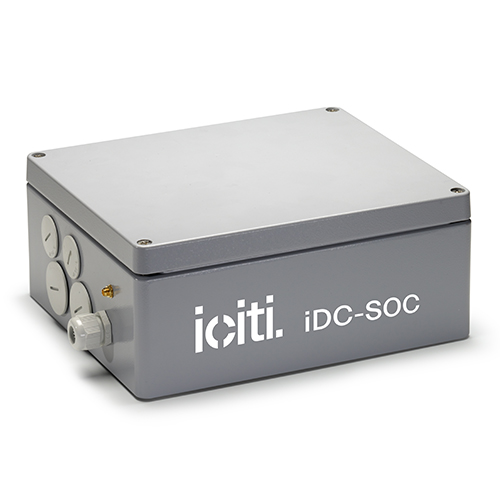
iDC-SOC
intelligent Data Concentrator
intelligent Data Concentrator
The data concentrator iDC-SOC forms the intelligent interface between the luminaire controllers in the field and the central control technology (f.e. SCADA).
As a major connecting element of the lighting management system, the iDC-SOC enables direct access to each luminaire controller via narrowband and broadband powerline technology standardised in accordance with CENELEC 50061-1, ANSI/CTA (709.1, 709.2, 709.8) and EN (14908-1, 14908-3, 14908-8).
In combination with the RF MESH interface iARM, data can be transmitted in accordance with ANSI/ CTA 709.11 and EN 14908-11 (in preparation).
This makes it easy to convert and expand existing powerline street lighting systems to radio trans- mission.
The iDC-SOC decentralises important control technology functions in order to additionally ensure the autonomous and self-sufficient operation of the lighting system.
Beneftis
- Transmission options: 4G (optional 5G) router, IP/Ethernet cable or fibre optics
- Connection of the field level via widespread mobile networks of different providers
- In parallel or alternatively, the iDC-SOC can also be integrated into an IP network via a Ethernet cable
- Integrated TALQ-2 interface
- With the separate commissioning software iCT-IOT, projects can be set up conveniently and in a time-saving manner
- 2 years warranty
Typical Applications
- Street and building-related lighting with direct integration via an OPC UA client-server architecture
- Tunnel lighting
- Sports lighting
- Building automation
Downloads

The data concentrator iDC-SOC forms the intelligent interface between the luminaire controllers in the field and the central control technology (f.e. SCADA).
As a major connecting element of the lighting management system, the iDC-SOC enables direct access to each luminaire controller via narrowband and broadband powerline technology standardised in accordance with CENELEC 50061-1, ANSI/CTA (709.1, 709.2, 709.8) and EN (14908-1, 14908-3, 14908-8).
In combination with the RF MESH interface iARM, data can be transmitted in accordance with ANSI/ CTA 709.11 and EN 14908-11 (in preparation).
This makes it easy to convert and expand existing powerline street lighting systems to radio trans- mission.
The iDC-SOC decentralises important control technology functions in order to additionally ensure the autonomous and self-sufficient operation of the lighting system.
Beneftis
- Transmission options: 4G (optional 5G) router, IP/Ethernet cable or fibre optics
- Connection of the field level via widespread mobile networks of different providers
- In parallel or alternatively, the iDC-SOC can also be integrated into an IP network via a Ethernet cable
- Integrated TALQ-2 interface
- With the separate commissioning software iCT-IOT, projects can be set up conveniently and in a time-saving manner
- 2 years warranty
Typical Applications
- Street and building-related lighting with direct integration via an OPC UA client-server architecture
- Tunnel lighting
- Sports lighting
- Building automation
Downloads
-
Technical Details
-
Additional Info
-
Tender Text
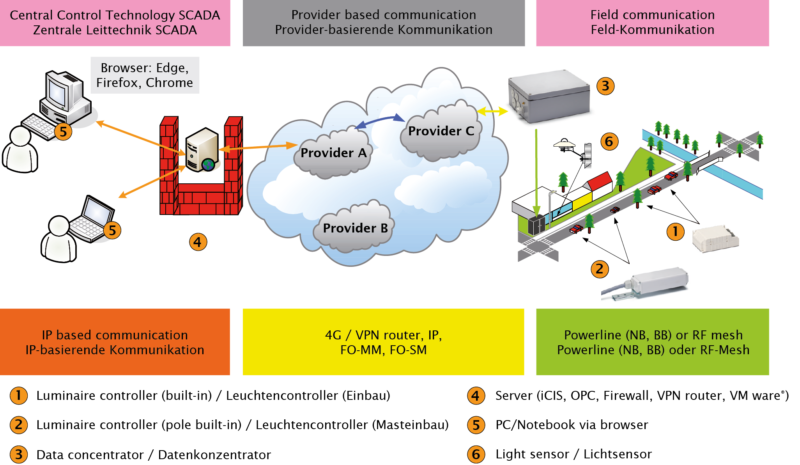
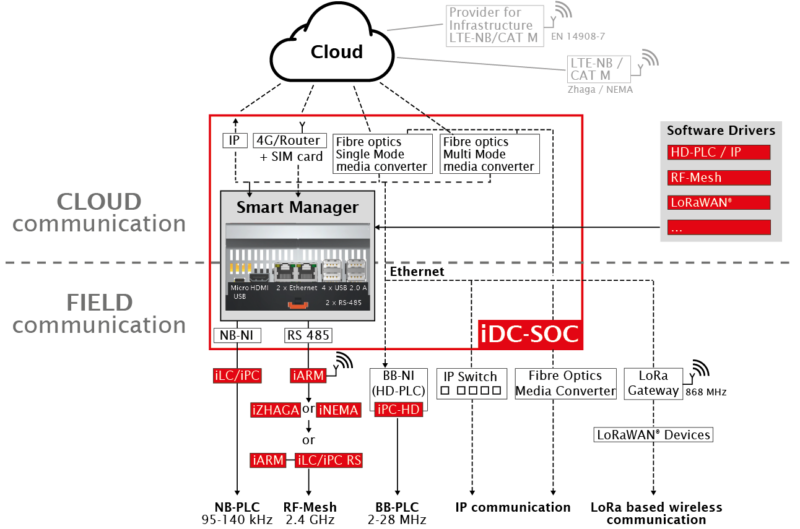
System Overview
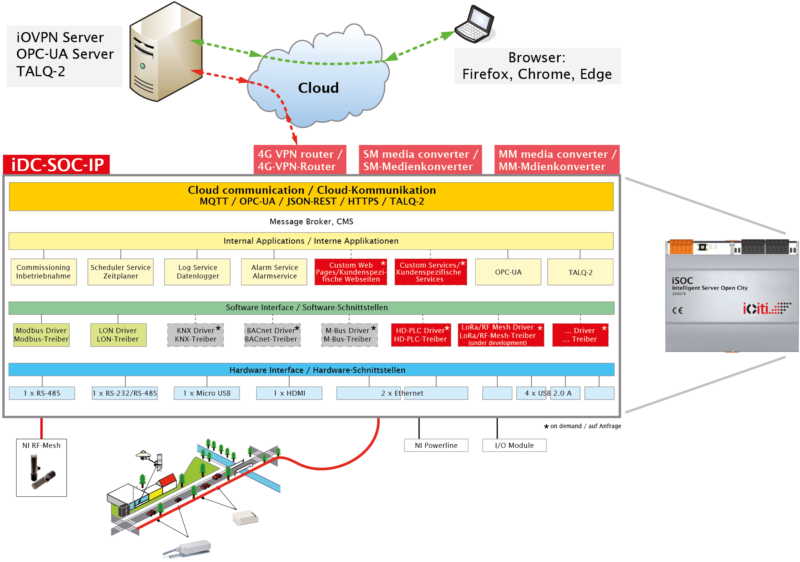
The iDC-SOC’s Local Application Intelligence
Thanks to its integrated Smart Manager, the iDC-SOC is equipped with the key applications that enable it to be integrated into a light management system.
Safe and reliable operation of the system as a whole is largely dependent on the architecture of the lighting control system.
If the transmission channel between the control technology and the iDC-SOC fails, this usually results in the subsequent failure of all downstream components. To avoid this situation, timer programs can be activated in the iDC-SOC, which are astronomically controlled and can be synchronised via SNTP with an appropriate delay to take over the task and provide redundancy.
A similar safeguard is provided for recording data generated by luminaire controllers. The Smart Manager of the iDC-SOC contains locally integrated data loggers which are capable of recording generated data, even for days at a time, and can then transfer these data to the control technology, usually on a daily basis, but just as easily after a few days in the event of a communication breakdown.
Most importantly, though, no data are lost. As the system is designed for universal use, it can be configured
to suit highly disparate applications. The applications shown in the chart are integral parts of the iDC-SOC’s local intelligence and can be remotely configured using the available communication channels.
Functions
- Real-time clock: Incl. astronomical calendar; with a power reserve, synchronisable
- Time synchronisation: Optional via (SNTP) server; (provided technical conditions exist)
- Timer-based control: Planning and activation of repetitive control tasks
- Data logger: Monitoring of process data of the luminaire controllers
- Alarm: Monitoring of processes and triggering of defined actions
- Email client: To send predefined information
- IO converter (only NB-IO versions): Conversion of digital input signals into a process date and inverse
- Operating system: Linux; updateable
- Programmable
Software Framework
The software framework is a web service that can run on an embedded controller, PC or enterprise system. The universal management tool for BACnet, M-Bus, LON, Modbus and other fieldbuses enables the commissioning and control of different systems and devices, wired or wireless. This makes it possible to install devices from different manufacturers with different protocols and to combine them in a simple, intuitive way.
The software framework has an integrated web HMI tool and a user-specific web interface in accordance with the HTML5 standard. HTML5 is supported by all common browsers worldwide. HMI interfaces created with this tool are:
- platform-independent
- high performance
- very easy to develop
- intuitive to use
- expandable at any time
- future-proof
Protocol-independent automation objects are created for:
- Alarms (display and management)
- Trends (display and comparison)
- Time control / calendar
- Logic programming according to IEC 61131
- Gateway functions (including data conversion)
The iDC-SOC makes it possible to connect any type of visualisation or SCADA system via JSON/Rest, OPC UA, SOAP, XML or BACnet. The distributed IT architecture of the connected servers can be accessed at any time via the web service. The web service can be hosted on any server under Windows, Android or Linux.

Intelligent Data Concentrator / Edge Controller (iDC-SOC)
1. Brief description
Data concentrator and electronic edge controller acting as a central interface between luminaire controllers in the field and a higher-level control system, such as SCADA or a Central Management System (CMS). The iDC-SOC enables direct access to individual luminaire controllers via standardised narrowband and broadband powerline technology, as well as optionally via RF mesh. Integrated local applications provide key control system functions in a decentralised manner, ensuring that the lighting system can continue to operate autonomously and independently even in the event of a communication failure with the SCADA system.
2. Detailed description (system description)
Configuration of an intelligent, decentralised control and communication system for street and building-adjacent lighting, tunnel lighting, sports lighting and building automation. Integration into higher-level systems takes place directly via an OPC UA or TALQ-2 client-server architecture. As a key link in the lighting management system, the data concentrator acts as the interface between the luminaire controllers in the field and the central control system.
Communication with the field devices takes place via narrowband and broadband powerline technologies standardised in accordance with CENELEC 50065-1, ANSI/CTA 709.1, 709.2, 709.8 and the European standards EN 14908-1, EN 14908-3 and EN 14908-8. In combination with the optional iARM-I active radio module, data transmission can also take place via RF mesh in accordance with ANSI/CTA 709.11 and EN 14908-11 (in preparation). This allows existing powerline street lighting systems to be easily supplemented with radio communication or gradually upgraded to RF mesh.
Depending on the device variant, IP/Ethernet, mobile communications via an integrated 4G router (with optional 5G) or fibre-optic cables are available for connection to the control system. The mobile connection can be established via widely used networks from various providers; in parallel or as an alternative, integration via Ethernet into an existing IP network is possible. The certified iCiti-TALQ app provides a TALQ-2 interface. Commissioning software supports the convenient and time-saving set-up of projects.
The integrated Smart Manager handles local time programmes, astronomical controls, data logging, alarm processing and communication tasks. In the event of a failure in the transmission channel between the control system and the iDC-SOC, local time-switch programmes – which can be synchronised via SNTP and RTC – can take over control. Integrated data loggers buffer process data over several days and transmit this to the control system once the connection is restored, thereby preventing data loss.
3. Technical Specifications (Items in the Specification of Works)
Item 1: High-level system description & software framework
Technical Specification
Intelligent data concentrator and electronic edge controller for lighting management, smart city and building automation applications. The system is designed as a decentralised, interoperable platform and controls field devices via powerline and RF mesh. It connects to the higher-level control system via IP-based communication. The edge controller ensures autonomous continued operation and controls essential functions in the event of a failure in the connection to the central control system.
Communication and System Integration:
- Connection to master computers and control systems via TCP/IP, UDP, HTTP, HTTPS, SMTP, POP3, MQTT/REST, OpenVPN, OPC UA and TALQ-2.
- Support for the ANSI/CTA 709.1, 709.2, 709.8 and 852 protocols for the US market, and EN 14908-1, EN 14908-3, EN 14908-4 and EN 14908-8 for Europe.
- Broadband powerline via an external HD-PLC coupler with IP connectivity, for example the iPC-HD, including the necessary software driver.
- Narrowband powerline in accordance with CENELEC 50065-1 in primary band C from 125 to 140 kHz and in secondary band B from 95 to 125 kHz; single-phase, two-phase or three-phase operation.
- Optional RF mesh operation via the iARM-I active radio module in accordance with ANSI/CTA 709.11 and EN 14908-11 (in preparation).
- Manager/subordinate communication for up to 1,000 luminaire controllers with repetitive, dynamic monitoring of the communication path; in narrowband powerline operation, a maximum of 200 luminaire controllers per iDC-SOC is recommended.
Software framework:
- Integrated, platform-independent, Linux-based web service serving as a universal management tool for LON, Modbus and other fieldbuses; optional support for BACnet, M-Bus and KNX.
- Interoperable use of network variables and configuration parameters in accordance with the LonMark® OLC profile.
- Integrated web HMI tool and customisable web interface based on the HTML5 standard; platform-independent, high-performance, intuitive to use, expandable and future-proof.
- Open interfaces for connecting visualisation and SCADA systems via JSON/REST, OPC UA, or optionally BACnet.
- Protocol-independent automation objects for alarm display and management, trends, time control and calendars, logic programming in accordance with IEC 61131, as well as gateway functions including data conversion.
- Certified TALQ-2 connectivity via the optional iCiti-TALQ app, version 2.7.0.
- Web service on distributed IT architectures; hosting on servers running Windows, Android or Linux is possible.
Item 2: Functional requirements / Device software functions
The data concentrator on offer comes as standard with the following integrated, software-based core functions, enabling it to carry out autonomous control, monitoring, data logging and communication tasks directly at field level:
- Real-time clock and astronomical calendar:
Integrated real-time clock with power reserve and astronomical calendar for controlling lighting systems based on time of day and location; can be synchronised. - Time synchronisation:
Optional synchronisation via an SNTP server, provided the technical requirements are met. - Time control:
Scheduling and automatic triggering of recurring control tasks. Local time programmes that are activated as a redundancy measure in the event of a failure in the connection to the control system. - Process data logging and monitoring:
Integrated data loggers for the continuous acquisition, recording and monitoring of process data from connected luminaire controllers. The data is buffered over several days and transferred to the control system without data loss once communication is restored. - Message and alarm management:
Continuous monitoring of processes and system statuses, with the option to trigger automated actions in response to defined events or threshold values. - Email client:
Integrated client for the automated sending of predefined status, alarm and system information. - I/O converter (NB-IO versions only):
Conversion of digital input signals into process data, and reverse conversion to control digital outputs. - Operating system and programmability:
Updatable Linux operating system; freely programmable status LED and freely programmable pushbutton. - Security and network integration:
Integrated OpenVPN client for secure and encrypted integration into a virtual private network via TLS/SSL connections.
Item 3.1: Base unit A – Data concentrator, type: iDC-SOC-IP
Technical specifications
Electronic edge controller and intelligent data concentrator in a robust aluminium housing with IP/Ethernet connectivity for lighting management and automation tasks.
- Models / Brand:
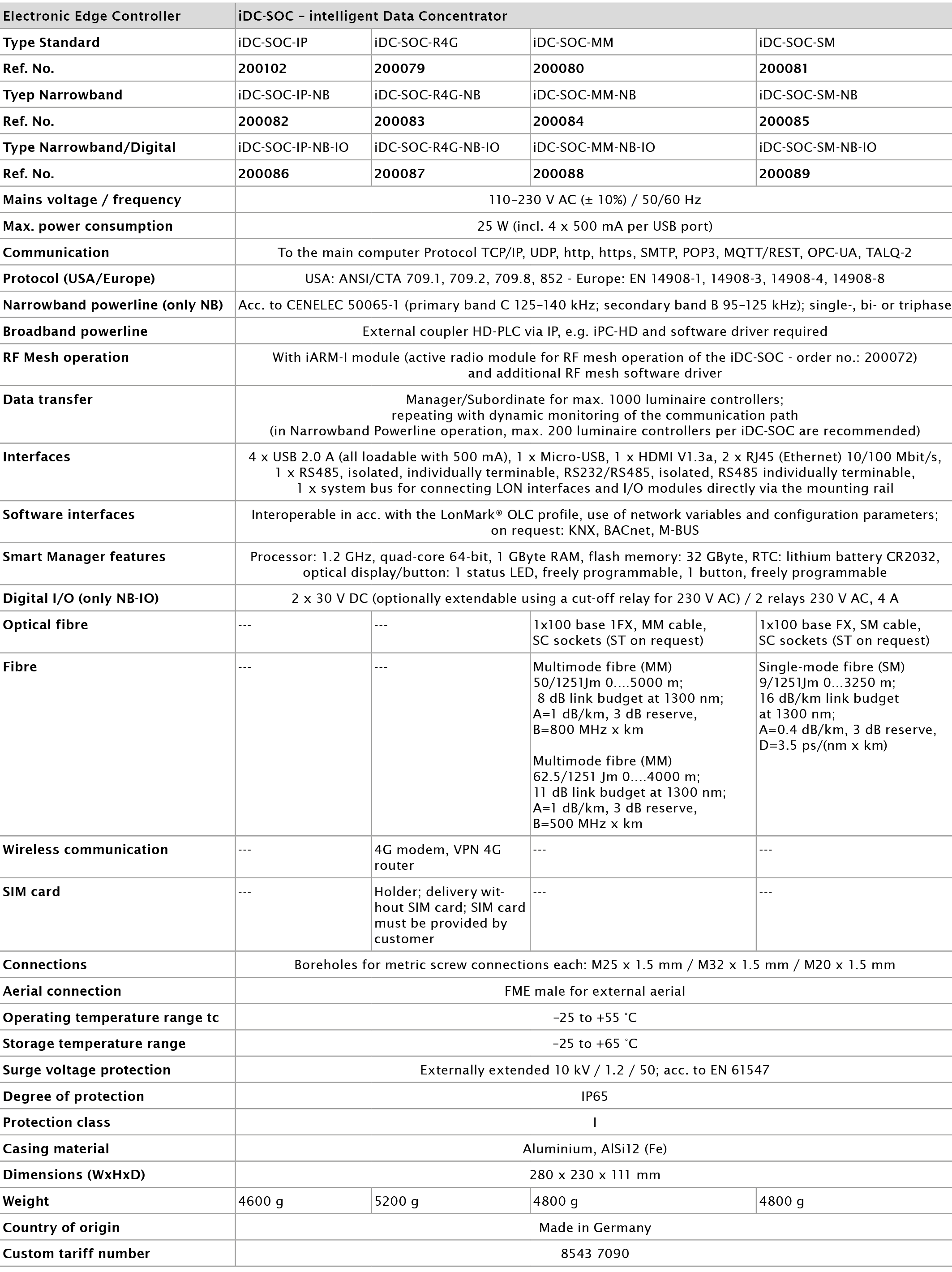
Standard type: iCiti iDC-SOC-IP (Ref. No. 200102); Narrowband type: iCiti iDC-SOC-IP-NB (Ref. No. 200082); Narrowband/Digital type: iCiti iDC-SOC-IP-NB-IO (Ref. No. 200086); as specified or equivalent. - Mains voltage / Mains frequency:
110–230 V AC (± 10 %) / 50–60 Hz. - Maximum power consumption:
25 W, including a maximum load of 4 x 500 mA on the USB ports. - Processor and RAM:
1.2 GHz quad-core 64-bit processor, 1 GB RAM. - Flash memory:
32 GB. - Real-time clock:
RTC with CR2032 lithium battery. - Visual indicators / buttons:
1 freely programmable status LED and 1 freely programmable button. - On-board interfaces:
4 x USB 2.0 Type A, each capable of supplying 500 mA; 1 x Micro-USB; 1 x HDMI V1.3a; 2 x RJ45 Ethernet 10/100 Mbit/s; 1 x RS-485, isolated and individually terminatable; 1 x RS-232/RS-485, isolated, RS-485 individually terminatable. - System bus:
Integrated DIN rail system bus for direct connection of LON interfaces and I/O modules via the DIN rail. - Communication with the master computer:
TCP/IP, UDP, HTTP, HTTPS, SMTP, POP3, MQTT/REST, OpenVPN, OPC UA and TALQ-2. - Data transfer and standards:
USA: ANSI/CTA 709.1, 709.2, 709.8 and 852; Europe: EN 14908-1, EN 14908-3, EN 14908-4 and EN 14908-8; interoperable in accordance with the LonMark® OLC profile. - Broadband powerline:
External HD-PLC coupler via IP, for example iPC-HD, and software drivers required. - Narrowband powerline (NB and NB-IO only):
In accordance with CENELEC 50065-1, primary band C 125–140 kHz and secondary band B 95–125 kHz; single-phase, two-phase or three-phase. - RF mesh operation:
Optional with active iARM-I radio module (Ref. No. 200072). - Network capacity:
Manager/subordinate operation for up to 1,000 luminaire controllers with repetitive, dynamic monitoring of the communication path; in narrowband powerline operation, a maximum of 200 luminaire controllers per iDC-SOC is recommended. - Optional software interfaces:
KNX, BACnet and M-Bus on request. - Digital interfaces (NB-IO only):
2 digital inputs for 30 V DC, optionally expandable to 230 V AC via isolating relays; 2 relay outputs for 230 V AC, 4 A. - Cable entries:
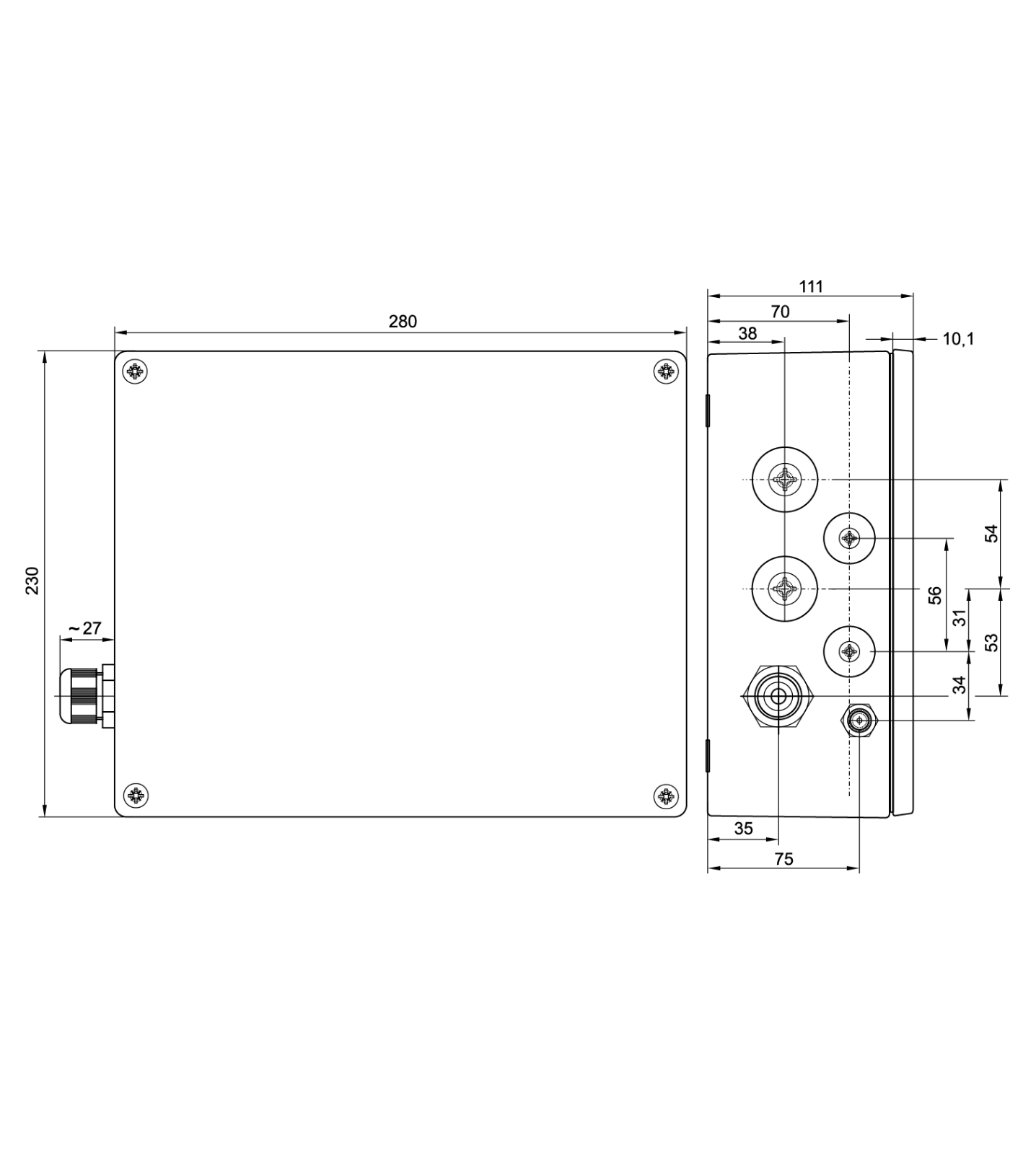
Holes for metric screw connections: 1 x M25 x 1.5 mm; 1 x M32 x 1.5 mm; 1 x M20 x 1.5 mm. - Antenna connection:
FME male for an external antenna. - Operating temperature range tc:
–25 to +55 °C. - Storage temperature range:
–25 to +65 °C. - Surge voltage resistance:
Externally extended to 10 kV / 1.2/50 in accordance with EN 61547. - Protection rating / protection class:
IP65 / Protection class I. - Housing material:
Aluminium, AlSi12 (Fe). - Dimensions (W x H x D):
280 x 230 x 111 mm. - Weight:
4,600 g. - Country of origin:
Manufactured in Germany. - Customs tariff number:
8543 7090. - Warranty:
2 years.
Item 3.2: Alternative item B – Data concentrator type: iDC-SOC-R4G
Technical Specification
Electronic edge controller and intelligent data concentrator with integrated 4G VPN router. In all other respects, the technical requirements of the base item iDC-SOC-IP apply, unless otherwise specified below.
- Models / Brand:
Standard type: iCiti iDC-SOC-R4G (Ref. No. 200079); Narrowband type: iCiti iDC-SOC-R4G-NB (Ref. No. 200083); Narrowband/Digital version: iCiti iDC-SOC-R4G-NB-IO (Ref. No. 200087); either of these or equivalent. - Wireless communication:
Integrated 4G modem and VPN-4G router for connection via mobile networks from various providers; a 5G version must be available as an option. - SIM card:
Integrated SIM card holder. The SIM card is not included and must be provided by the customer. - Parallel network connection:
In addition or as an alternative, integration into an existing IP network via Ethernet must be possible. - Weight:
5,200 g. - Warranty:
2 years.
Item 3.3: Alternative item C – Data concentrator type: iDC-SOC-MM
Technical Specification
Electronic edge controller and intelligent data concentrator with integrated multimode fibre-optic interface. In all other respects, the technical requirements of the base item iDC-SOC-IP apply, unless otherwise specified below.
- Models / Brand:
Standard type: iCiti iDC-SOC-MM (Ref. No. 200080); Narrowband type: iCiti iDC-SOC-MM-NB (Ref. No. 200084); Narrowband/Digital type: iCiti iDC-SOC-MM-NB-IO (Ref. No. 200088); as specified or equivalent. - Fibre-optic interface:
1 x 100 Base-FX for MM cable with SC sockets; ST sockets on request. - Multimode fibre 50/125 µm:
Transmission distance 0–5,000 m; 8 dB link budget at 1,300 nm; attenuation A = 1 dB/km; 3 dB margin; bandwidth-length product B = 800 MHz × km. - Multimode fibre 62.5/125 µm:
Transmission distance 0–4,000 m; 11 dB link budget at 1,300 nm; attenuation A = 1 dB/km; 3 dB margin; bandwidth-length product B = 500 MHz × km. - Weight:
4,800 g. - Warranty:
2 years.
Item 3.4: Alternative item D – Data concentrator type: iDC-SOC-SM
Technical Specification
Electronic edge controller and intelligent data concentrator with integrated single-mode fibre-optic interface. In all other respects, the technical requirements of the base item iDC-SOC-IP apply, unless otherwise specified below.
- Models / Brand:
Standard type: iCiti iDC-SOC-SM (Ref. No. 200081); Narrowband type: iCiti iDC-SOC-SM-NB (Ref. No. 200085); Narrowband/Digital type: iCiti iDC-SOC-SM-NB-IO (Ref. No. 200089); as specified or equivalent. - Fibre-optic interface:
1 x 100 Base-FX for SM cable with SC sockets; ST sockets on request. - Single-mode fibre 9/125 µm:
Transmission distance 0–3,250 m; 16 dB link budget at 1,300 nm; attenuation A = 0.4 dB/km; 3 dB margin; dispersion D = 3.5 ps/(nm x km). - Weight:
4,800 g. - Warranty:
2 years.
Item 4: Optional accessories – Active RF mesh radio module
Technical Specification
Active radio module for extending the iDC-SOC with RF mesh communication and for the gradual expansion or retrofitting of existing powerline lighting systems to radio communication.
- Function:
RF mesh interface for data transmission between the iDC-SOC and luminaire controllers in accordance with ANSI/CTA 709.11 and EN 14908-11 (in preparation). - Integration:
Connection to the iDC-SOC; dynamic, continuous monitoring of communication paths within the mesh network. - Brand:
iCiti iARM-I, active radio module for RF mesh operation of the iDC-SOC (Ref. No. 200072) or equivalent.
Item 5: Optional accessories – Certified TALQ interface app
Technical Specification
Certified software application for extending the iDC-SOC with a fully-fledged, manufacturer-independent TALQ-2 interface.
- Protocol standard:
TALQ certification in accordance with version 2.7.0 - Function:
Functions as an embedded TALQ gateway for the seamless and interoperable connection of existing LON networks via powerline in accordance with EN 14908-3, as well as modern wireless mesh networks, to any TALQ-compliant Central Management System. Compliance with the open standard must allow for the free choice of CMS and device manufacturers. - Brand:
iCiti TALQ app (Ref. No. 200114) or equivalent.